
Is motivation the key to retention in Civil Protection organisations?
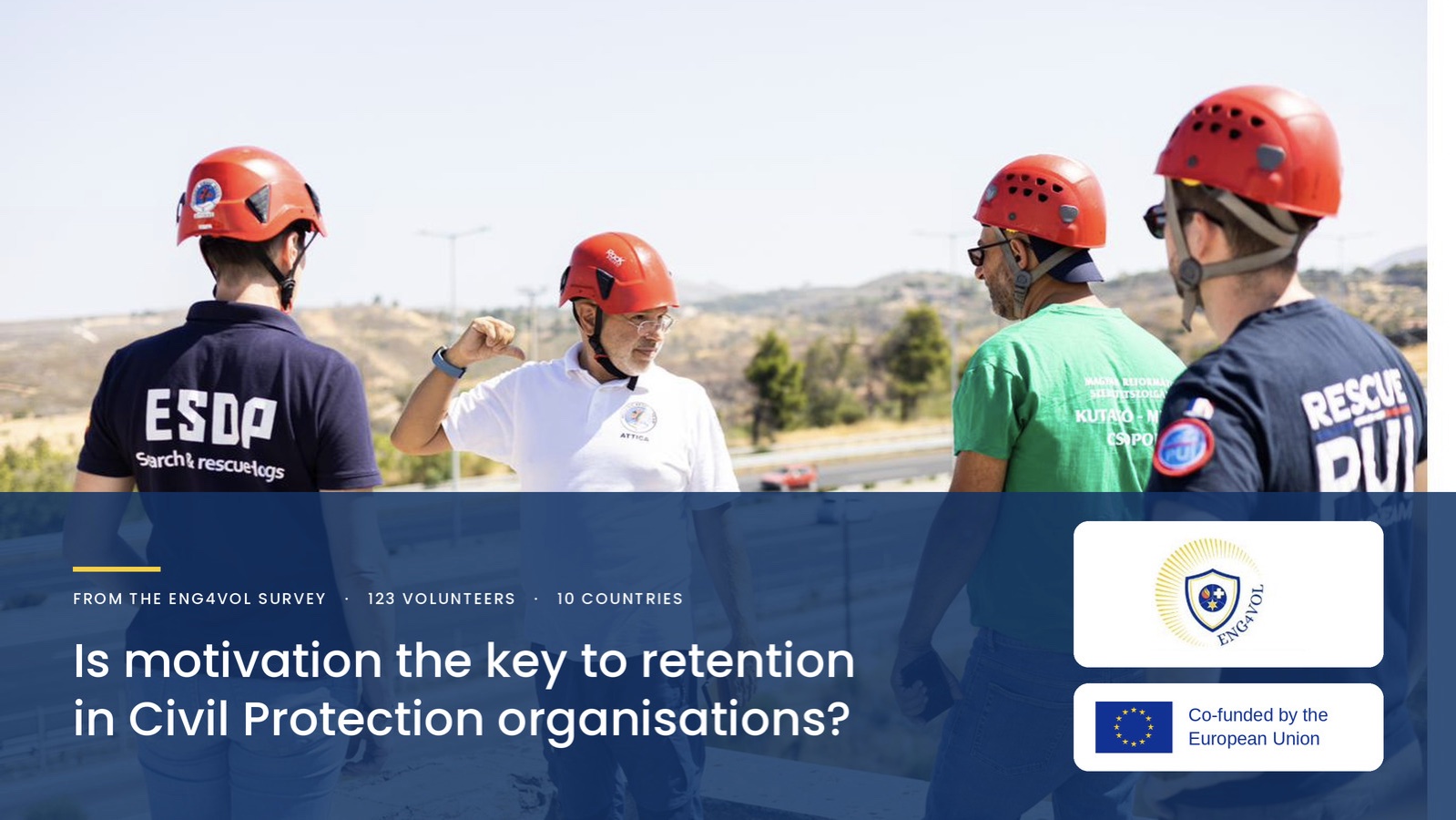
ENG4VOL asked 123 civil protection volunteers across ten European countries why they joined, what keeps them going, and what has made some of them think about quitting. Their answers point to one conclusion: motivation is rarely the problem.
Why people sign up
Ask a civil protection volunteer why they do it and the answer is remarkably consistent. In the ENG4VOL survey, 88% said they joined out of a desire to help their community, and 76% pointed to a personal interest in emergency response. For 42%, a previous experience with an emergency had left its mark; they had seen for themselves what timely help means. Career development came up too, but only for 18%, and around 15% were brought in by a friend or family member.
Beyond the tick boxes, volunteers added reasons in their own words: ethical commitment and humanitarian values, a passion for rescue missions, an emotional connection to past disasters, and the wish to take part in international operations.
The mix shifts a little with age and experience. Younger volunteers were more likely to mention career growth and learning new skills, while older volunteers spoke more about community service and emotional fulfilment. Women more often mentioned empathy and supporting vulnerable people, and men more often mentioned the operational and technical side of the work. Underneath these differences the core is the same. People join because they want to be useful to others.
What keeps them going
Most of the volunteers we heard from are seasoned. More than half have been active for at least four years, and nearly a third for more than a decade. When they described what keeps them going, they returned to the same themes: helping others, a sense of purpose, the camaraderie of the team, and the chance to keep learning.
Their most rewarding moments are concrete. Nearly half named emergency response missions, about a third spoke of saving lives or helping people in a crisis, and about a quarter mentioned the gratitude of the people they helped.
This shows in the satisfaction figures. Nearly 85% are satisfied with their role, 76% feel valued and recognised, and 82% feel their organisation supports them adequately. Three in four said the expectations they had on joining have been met. More than nine in ten would recommend civil protection volunteering to others.
What makes them think about leaving
Even so, 28% have considered leaving at some point, while 70% never have. The reasons say a lot. Among those who had thought about it, time constraints came first, followed by feeling unsupported or unrecognised, emotional strain, the cost of equipment and travel, and poor communication.
Equipment deserves a closer look, because it was the single most common challenge volunteers named. 45% cited a lack of resources or equipment, ahead of time pressure (40%) and poor internal communication (25%). One in three volunteers (32.5%) pay for their own gear, and nearly one in four said they had not received the equipment they need. Emotional strain is also real. While 71% found debriefings after operations helpful, only 63% felt emotionally supported by their organisation during tense situations, and around 16% felt they were not.
The project's Lessons Learnt report draws the conclusion plainly. The main risks of losing volunteers are organisational, not motivational. Volunteers stay when they feel supported, and they turn away when they feel taken for granted.
What organisations can do
When volunteers were asked how their organisation could improve engagement, the same requests came up most often: more practical training, better internal communication, recognition of their efforts, access to equipment without personal cost, backing from public institutions, and a say in decisions.
The Lessons Learnt report turns these into concrete steps. Give every new volunteer a mentor from day one and train with realistic scenarios. Make recognition an everyday habit; a few words from an operations lead after a long, hard operation are worth more than an awards ceremony at the end of the year. Involve volunteers in decisions about training, equipment and operations, and open routes to new roles such as mentoring, training others or coordinating. Provide essential equipment free of charge, with clear replacement schedules, and look to sponsorships or grants where budgets fall short. Make debriefing standard after every operation and offer structured psychosocial support. Some barriers sit with public institutions rather than organisations: legal recognition of civil protection volunteering, and justified leave for deployments, so that volunteers no longer have to use their annual leave to respond to an emergency.
The short version
Volunteers arrive ready to give. Whether they stay comes down to three things: being prepared through training, valued through recognition, and part of a mission that matters. These principles, along with practical guidance for organisations, coordinators and policy makers, are set out in the ENG4VOL Pocket Guide, available to download here: https://eng4volproject.eu/project-activities/
